Table of Contents
Four New Automotive Contenders Target India: JSW Motors, Genesis, Leapmotor and Slate Auto
India’s passenger vehicle market is undergoing one of its most dynamic phases in decades. What was long a domain of affordable petrol and diesel cars has evolved into a multi-layered battleground of electric vehicles, hybrids, premium SUVs and genuine luxury offerings. Against this backdrop, four names are generating particular interest: JSW Motors, Hyundai’s Genesis, Stellantis-backed Leapmotor, and the American startup Slate Auto.
These brands sit at very different stages of their India journeys. Some have concrete manufacturing and product roadmaps. Others remain speculative. Together they illustrate why India has become a strategic priority for both domestic conglomerates and global players seeking growth beyond saturated Western and Chinese markets.
The Broader Indian Context
India’s passenger vehicle market continues to expand, with wholesale volumes around 4.6–4.7 million units in recent fiscal years and expectations of further growth into the mid-single digits. SUVs now dominate, accounting for roughly 60–65% of sales. Electrification is accelerating: battery-electric passenger vehicle sales nearly doubled in some recent periods, with penetration rising toward 5% and higher in certain months. Premium and luxury segments, while still small in absolute volume (around 50,000 units annually for true luxury), show strong demand for electrified powertrains—nearly half of vehicles priced above ₹30 lakh in early 2026 periods were electrified.
Localisation remains critical. High import duties make completely built-up imports uncompetitive in most segments. Successful entrants will need local assembly or full manufacturing, deep supplier networks, and products calibrated to Indian roads, climate, pricing expectations and ownership costs. Charging infrastructure, residual values and total cost of ownership continue to shape buyer decisions, especially outside the pure luxury tier.
This environment creates openings for new brands that can offer differentiated technology, aggressive value, premium experiences or modular simplicity.
1. JSW Motors – India’s Newest Homegrown New-Energy Player
JSW Group already has a major foothold through its joint venture with MG Motor India. Now it is building a fully independent passenger vehicle brand under JSW Motors, focused squarely on new-energy vehicles (NEVs)—battery electrics, plug-in hybrids, range-extenders and related technologies.
The company is constructing a large greenfield facility in Chhatrapati Sambhajinagar (formerly Aurangabad), Maharashtra, on hundreds of acres. Initial annual capacity targets sit in the 350,000–500,000 vehicle range, with expansion potential toward 1 million. Significant funding has been secured, including substantial long-term project finance, and the group is investing in battery cell manufacturing (plans for a multi-GWh lithium-ion plant with partners) and software-defined vehicle capabilities through partnerships such as with Tata Elxsi.
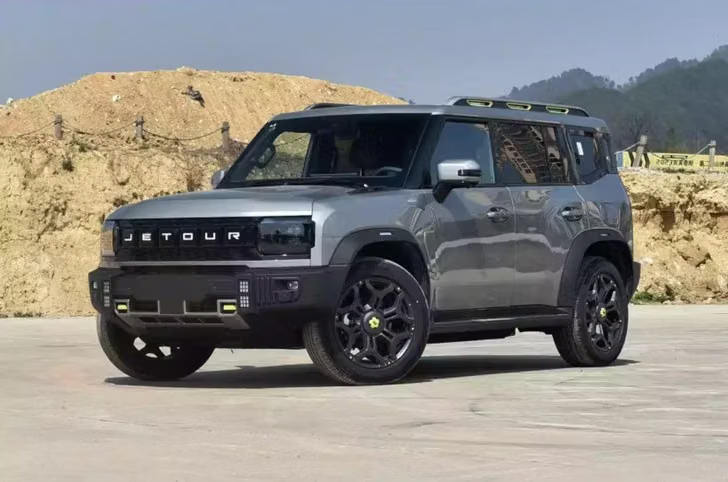
Product ambitions are aggressive: up to 15 models over roughly four years, spanning price points from the mid-teens of lakhs into the ₹30–45 lakh premium territory. Early candidates linked to Chinese technology partners (rebadged or adapted models from Chery-related brands such as Jetour and Jaecoo) include rugged plug-in hybrid SUVs and electric crossovers. The first vehicles are expected around the Diwali 2026 festive season, with bookings potentially opening in late 2026 and deliveries starting around year-end or early 2027. Platforms are being developed across multiple segments, and there is emphasis on localisation of components and a software-centric approach.
JSW Motors represents a significant domestic industrial play. Success would add another large Indian conglomerate to the ranks of full-line passenger vehicle makers, intensifying competition with Tata Motors and Mahindra in the growing NEV space while also targeting higher-margin segments. Challenges include technology transfer restrictions, rapid scaling of quality and brand perception, and building a dealer and service network from a relatively clean sheet (while potentially leveraging group resources).
2. Genesis – Hyundai’s Luxury Offensive
Genesis, Hyundai Motor Group’s premium brand, is positioned as the most straightforward luxury entrant among the four. Hyundai has confirmed plans to introduce Genesis in India by 2027, with local assembly as a core element of the strategy. This is part of a larger multi-year investment roadmap involving dozens of new models across the Hyundai and Kia portfolios and deeper localisation.
Local production or CKD assembly would allow Genesis to avoid the full weight of import duties that burden many European luxury competitors, potentially enabling more competitive pricing in the ₹50 lakh to ₹1 crore-plus territory. Likely early products include mid-size and larger SUVs such as the GV70 and GV80 (and possibly coupe variants), which align with India’s strong preference for high-riding vehicles. Electric variants from the global lineup could follow as the market matures.
Hyundai has already appointed dedicated leadership for the Genesis vertical in India and can leverage its extensive manufacturing footprint (including facilities in Tamil Nadu and elsewhere), supplier base and brand equity. The brand’s global reputation for design, technology and value-oriented luxury positions it to challenge the established German trio (Mercedes-Benz, BMW, Audi) and others, particularly among buyers seeking alternatives with strong feature content and potentially lower total ownership costs.
The luxury segment remains small but is premiumising and electrifying rapidly. Genesis’ success will hinge on creating a distinct ownership experience—exclusive showrooms, service standards and brand storytelling—while delivering products that feel special rather than simply upscale Hyundais.
3. Leapmotor – Stellantis’ Chinese EV Bridge
Leapmotor, a Chinese electric vehicle specialist, enters the picture through its close partnership with Stellantis. Stellantis holds a significant minority stake and controls Leapmotor International (the joint venture with exclusive rights for markets outside Greater China). Stellantis already operates Jeep and Citroën in India and has manufacturing capacity, notably in Maharashtra and Tamil Nadu.
Leapmotor focuses on technology-rich yet relatively affordable battery-electric vehicles. Potential India products include compact and mid-size electric SUVs (such as B10 and C10 derivatives) and possibly smaller models that could compete in high-volume EV segments currently led by Tata, Mahindra, MG and others. Initial plans point toward CKD assembly at existing Stellantis facilities to manage costs and duties, with the possibility of progressive localisation.
The brand offers Stellantis a ready-made EV portfolio with competitive cost structures developed in China, helping accelerate its electrification efforts without the full expense and time of internal development. For Indian buyers it could mean well-equipped electric SUVs at accessible price points relative to some premium alternatives. Timing has shifted from earlier expectations, with meaningful launches more likely in the 2026–2027 window depending on regulatory, supply-chain and market conditions.
Key variables include the degree of localisation achieved, how the brand is positioned relative to existing Stellantis offerings, and navigating any geopolitical or technology-transfer sensitivities. If executed well, Leapmotor could intensify competition in the mid-market EV SUV space that is expanding quickly.
4. for Slate Auto – The Speculative Modular Wildcard
Slate Auto is the most unconventional of the four. This American startup, backed by high-profile investors including interests linked to Jeff Bezos and others, is developing highly modular, minimalist and affordable electric vehicles. Its core concept centres on a simple electric pickup that can be transformed via accessory kits into SUV-style configurations or other body variants. The philosophy prioritises low base cost, repairability, customisation and manufacturing simplicity—features such as manual windows, minimal standard electronics and composite body panels in some descriptions—rather than feature-laden premium experiences.
Design-related intellectual property filings in India have sparked speculation about possible interest in the market. However, there is no official confirmation of manufacturing plans, dealer networks, launch timelines or India-specific pricing. Design protections are routinely filed for intellectual property reasons and do not equate to commercial entry plans. At present Slate remains a potential rather than confirmed entrant.
If it did pursue India, the modular, value-oriented approach could appeal in a market that rewards practicality and total cost of ownership. Challenges would be substantial: establishing local production or assembly, adapting to Indian regulations and infrastructure, building brand awareness, and competing against established players with far deeper local roots. For now it serves mainly as a reminder that innovative, lower-cost EV concepts continue to attract serious capital globally.
India Automotive — Field Notes
New Entrants,
Comparative Snapshot
| Brand | Origin / Backing | Primary Focus | India Status |
|---|---|---|---|
| 01JSW Motors | JSW Group (India) | NEVs — EV, PHEV, REEV etc., multi-segment | IN DEVELOPMENT Independent brand under development; first products targeted late 2026 / early 2027 |
| 02Genesis | Hyundai Motor Group (South Korea) | Luxury SUVs and cars (ICE + EV) | PLANNED 2027 Entry planned for 2027 with local assembly |
| 03Leapmotor | China / Stellantis-backed | Technology-focused electric vehicles | ANNOUNCED India entry announced; details and timing evolving |
| 04Slate Auto | USA / high-profile investors (incl. Bezos-linked) | Affordable modular EVs | SPECULATIVE IP activity noted, but no official launch confirmation |
Status reflects public statements as of Aug 2026 and is subject to change without notice.
Strategic Implications and Outlook
These four brands illustrate four distinct strategies: a domestic industrial conglomerate building an NEV ecosystem from the ground up (JSW); a global volume player leveraging its Indian manufacturing base to attack the luxury segment (Genesis); a Chinese EV specialist accessing India via a major Western partner’s infrastructure (Leapmotor); and a disruptive American startup exploring minimalist modular mobility (Slate).
If three of the four establish meaningful operations, competition will intensify across electric SUVs, premium new-energy vehicles, and the entry-to-mid luxury space. Established players such as Tata Motors, Mahindra, Hyundai/Kia, MG, Toyota, Maruti Suzuki and the German luxury brands will face additional pressure on technology, pricing, features and localisation. Buyers stand to benefit from greater choice, faster technology diffusion and potentially sharper value propositions.
Success is not guaranteed. Localisation depth, product-market fit, brand building, after-sales networks, charging ecosystem development and macroeconomic factors will all play decisive roles. Geopolitical considerations around technology partnerships, especially those involving Chinese IP, add another layer of complexity.
India’s automotive market is no longer primarily a story of volume at the bottom end. Premiumisation, electrification and the rise of multi-powertrain new-energy vehicles are reshaping the competitive landscape. JSW Motors, Genesis, Leapmotor and (potentially) Slate Auto are among the newer names testing that transformation. The next two to three years will reveal which of them translate ambition into sustained market presence—and how the incumbents respond.