On this page
In this story
- 1. What is Artificial Intelligence (AI)?
- 2. A Brief History of AI
- 3. How Does AI Actually Work?
- 4. Types of Artificial Intelligence
- 5. Machine Learning vs Deep Learning vs AI — What’s the Difference?
Last Updated: January 2025 | Reading Time: 15 minutes
Artificial Intelligence is no longer science fiction — it’s part of your daily life.
Every time you ask Siri a question, get a Netflix recommendation, or unlock your phone with your face, you’re using AI. In fact, 97 million people are expected to work in the AI industry by 2025, and the global AI market is projected to reach $407 billion by 2027.
But what exactly is artificial intelligence? How does it actually work? And why should you care?
Whether you’re a complete beginner, a student exploring tech, or a professional wanting to understand the AI revolution, this guide breaks everything down in simple, plain language — no technical jargon required.
By the end of this post, you’ll understand:
- ✅ What AI really means (and what it doesn’t)
- ✅ How artificial intelligence actually works
- ✅ The different types of AI
- ✅ Real-world examples you use every day
- ✅ Why AI matters for YOUR future
- ✅ How to start learning about AI today
Let’s dive in. 👇
What is Artificial Intelligence (AI)?
- A Brief History of AI
- How Does AI Actually Work?
- Types of Artificial Intelligence
- Machine Learning vs Deep Learning vs AI — What’s the Difference?
- Real-World Examples of AI in Everyday Life
- Benefits of Artificial Intelligence
- Risks and Challenges of AI
- AI in 2025: Current Trends and Future Predictions
- How to Start Learning About AI (Beginner Resources)
- Frequently Asked Questions (FAQ)
- Conclusion
1. What is Artificial Intelligence (AI)?
Artificial Intelligence (AI) is the ability of a computer or machine to perform tasks that normally require human intelligence.
These tasks include:
- 🧠 Thinking and reasoning
- 🗣️ Understanding human language
- 👁️ Recognizing images and faces
- 📊 Making decisions based on data
- 📚 Learning from experience
Simple Definition
AI = Teaching machines to think, learn, and make decisions like humans — but faster and at a much larger scale.
What AI is NOT
Many people have misconceptions about AI. Let’s clear them up:
| ❌ AI is NOT | ✅ AI IS |
|---|---|
| A robot that looks human | Software that processes data intelligently |
| Something that will “take over the world” | A tool built and controlled by humans |
| One single technology | A collection of many technologies working together |
| Only for tech experts | Used by everyone (even if you don’t realize it) |
| Perfect and error-free | Still evolving and sometimes makes mistakes |
Think of AI Like This
Imagine you’re teaching a child to recognize animals:
- You show them hundreds of pictures of cats and dogs
- Over time, they learn the patterns — cats have pointed ears, dogs have longer snouts
- Eventually, they can identify new animals they’ve never seen before
AI works the same way — except instead of hundreds of pictures, it processes millions or billions of data points, and it learns much faster.
2. A Brief History of AI
AI isn’t new — it’s been developing for over 70 years. Here’s a quick timeline:
text📅 AI TIMELINE

1950 → Alan Turing publishes "Computing Machinery and Intelligence"
        Asks: "Can machines think?" — Creates the famous "Turing Test"

1956 → The term "Artificial Intelligence" is officially coined
        at the Dartmouth Conference

1966 → ELIZA — the first chatbot — is created at MIT

1997 → IBM's Deep Blue beats world chess champion Garry Kasparov

2011 → IBM Watson wins Jeopardy! against human champions
        Apple launches Siri — AI enters smartphones

2014 → Amazon launches Alexa
        Google acquires DeepMind

2016 → Google's AlphaGo defeats world Go champion Lee Sedol

2020 → OpenAI releases GPT-3 — advanced language AI

2022 → ChatGPT launches — AI goes mainstream 🚀
        AI art tools (DALL-E, Midjourney) explode in popularity

2023 → GPT-4, Google Bard (Gemini), Claude AI release
        AI becomes the fastest-growing tech in history

2024-→ AI agents, multimodal AI, and industry-specific AI
2025    tools transform every sector
Key Takeaway: AI has been evolving for decades, but the last 3 years (2022-2025) have seen more progress than the previous 50 years combined.
3. How Does AI Actually Work?
At its core, AI works through a three-step process:
text         ┌──────────────┐
         │   📥 INPUT    │ ← Data goes in
         │  (Data)       │   (text, images, numbers)
         └──────┬───────┘
                │
                ▼
         ┌──────────────┐
         │  ⚙️ PROCESS   │ ← AI analyzes patterns
         │  (Algorithm)  │   (using math & statistics)
         └──────┬───────┘
                │
                ▼
         ┌──────────────┐
         │  📤 OUTPUT    │ ← Result comes out
         │  (Decision/   │   (prediction, answer,
         │   Prediction) │    recommendation)
         └──────────────┘
Breaking It Down Further
Step 1: Data Collection
AI needs data to learn — LOTS of data. This could be:
- Millions of text documents (for language AI like ChatGPT)
- Thousands of medical images (for diagnostic AI)
- Years of financial records (for prediction AI)
Step 2: Training the Model
The AI looks for patterns in the data:
- “Every time X happens, Y usually follows”
- “Images with these pixel patterns are usually cats”
- “Emails with these words are usually spam”
Step 3: Making Predictions
Once trained, the AI can look at new data it’s never seen and make intelligent predictions or decisions.
Real Example
How Gmail’s Spam Filter Works:
text1. 📥 INPUT    → Millions of emails (spam + legitimate)
2. ⚙️ TRAINING → AI learns patterns:
                  - Spam emails often contain "FREE MONEY!!!"
                  - Spam comes from suspicious addresses
                  - Spam has certain formatting patterns
3. 📤 OUTPUT   → When you receive a NEW email, AI instantly
                  decides: SPAM or NOT SPAM ✅
4. Types of Artificial Intelligence
AI can be categorized in two main ways:
Classification 1: By Capability
text┌─────────────────────────────────────────────────────┐
│                  TYPES OF AI BY CAPABILITY           │
├─────────────────────────────────────────────────────┤
│                                                     │
│  🟢 NARROW AI (Weak AI)                             │
│  ├── Designed for ONE specific task                 │
│  ├── This is what we have TODAY                     │
│  └── Examples: Siri, ChatGPT, Tesla Autopilot      │
│                                                     │
│  🟡 GENERAL AI (Strong AI)                          │
│  ├── Can perform ANY intellectual task like humans  │
│  ├── Does NOT exist yet                            │
│  └── Goal: AI that thinks like a human brain       │
│                                                     │
│  🔴 SUPER AI (Superintelligence)                    │
│  ├── Surpasses human intelligence in ALL areas     │
│  ├── Theoretical — may never exist                 │
│  └── This is what sci-fi movies depict             │
│                                                     │
└─────────────────────────────────────────────────────┘
Important: Every AI you interact with today — ChatGPT, Google, Alexa, Netflix — is Narrow AI. It’s incredibly powerful at specific tasks but cannot “think” like a human across all domains.
Classification 2: By Functionality
| Type | What It Does | Example |
|---|---|---|
| Reactive Machines | Responds to inputs, no memory | IBM Deep Blue (chess) |
| Limited Memory | Uses past data to make decisions | Self-driving cars, ChatGPT |
| Theory of Mind | Understands human emotions & thoughts | 🚧 Under development |
| Self-Aware AI | Has consciousness and self-awareness | ❌ Does not exist |
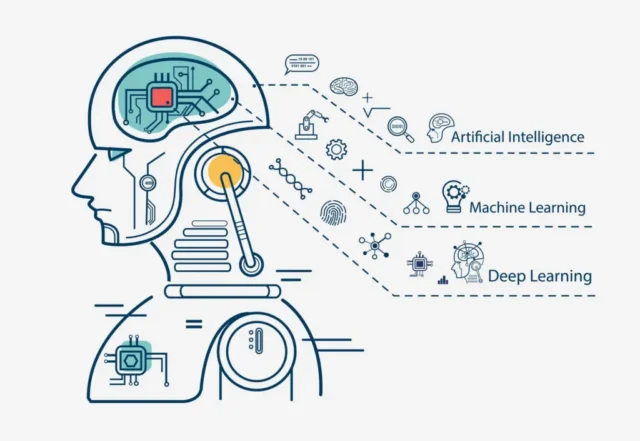
5. Machine Learning vs Deep Learning vs AI — What’s the Difference?
These terms are often used interchangeably, but they’re different things:
text┌─────────────────────────────────────────┐
│                                         │
│          🤖 ARTIFICIAL INTELLIGENCE      │
│          (The Big Picture)              │
│    ┌───────────────────────────┐        │
│    │                           │        │
│    │    📊 MACHINE LEARNING     │        │
│    │    (Subset of AI)         │        │
│    │  ┌───────────────────┐   │        │
│    │  │                   │   │        │
│    │  │  🧠 DEEP LEARNING  │   │        │
│    │  │  (Subset of ML)   │   │        │
│    │  │                   │   │        │
│    │  └───────────────────┘   │        │
│    │                           │        │
│    └───────────────────────────┘        │
│                                         │
└─────────────────────────────────────────┘
In frames · the AI desk
 Best Engineering Specializations to Study Abroad for Indian Students with High Job Demand
 Core vs IT Engineering Abroad: Which Path Gives Indian Students Better Career Growth?
 Best Countries to Study AI and Machine Learning Abroad for Indian Students in Future
Hover to fan the frames
Your take
Was this worth your time?
0 reactions