On this page
- Table of Contents
- Ankur Warikoo Recalls the Money Advice He Received 10 Years Ago
- Why Rs 10,000 Does Not Always Feel Like Rs 10,000
- The Same Money Can Feel Different Depending on How You Spend It
- Investing Is Not Just About Watching Numbers Grow
- Your Job Also Determines the “Colour” of Your Money
- Clients Can Also Change the Value of Your Income
- Ankur Warikoo’s Rs 100-Crore Business Journey Adds Context
- From Physics to Entrepreneurship: Warikoo’s Unusual Career Journey
- What Does “Colour of Money” Actually Mean?
- Why This Money Advice Is Different From “Earn More, Spend Less”
- The Bigger Lesson for Young Earners
- Ankur Warikoo’s Money Philosophy in One Question
- Ankur Warikoo Money Advice: Key Takeaway
- Frequently Asked Questions
In this story
- Table of Contents
- Ankur Warikoo Recalls the Money Advice He Received 10 Years Ago
- Why Rs 10,000 Does Not Always Feel Like Rs 10,000
- The Same Money Can Feel Different Depending on How You Spend It
- Investing Is Not Just About Watching Numbers Grow
Table of Contents
Ankur Warikoo Shares the Best Money Advice He Ever Got
The entrepreneur, content creator and financial educator recalls advice from an investor that changed the way he looked at earning, spending and investing money
Ankur Warikoo has shared a money lesson that he says has stayed with him for nearly a decade, and it is not about getting rich quickly, making risky investments or chasing the highest possible salary.
Instead, the entrepreneur says one of the most valuable pieces of financial advice he ever received was about understanding the “colour” of money.
Warikoo recently revisited a conversation he had with an investor around 10 years ago, when he was raising funds for a previous startup. According to Warikoo, the investor told him that money is not simply a number or a neutral figure sitting in a bank account.
The advice was that money carries a connection to how it is earned, where it comes from, how it is spent and what it ultimately brings into a person’s life.
That idea has now resurfaced in a post by Warikoo, who has built a large audience around entrepreneurship, careers, personal finance and self-improvement.
His latest message comes months after he announced the closure of a business that had generated Rs 100 crore in sales and around Rs 25 crore in profit, making his reflections on money particularly relevant to his audience.
Ankur Warikoo Recalls the Money Advice He Received 10 Years Ago
Warikoo said he received the advice while raising money for his previous startup.
The central idea was simple: money may look identical in numerical terms, but its impact can be completely different depending on the circumstances surrounding it.
A person earning Rs 10,000 from one job may feel proud and fulfilled, while the same amount earned from another job may come with stress or dissatisfaction.
For Warikoo, this is what gives money its “colour”.
The concept moves the discussion beyond simply asking how much money someone makes.
Instead, it raises a different question: what is the cost attached to earning that money?
Why Rs 10,000 Does Not Always Feel Like Rs 10,000
One of the most interesting parts of Warikoo’s explanation is his comparison between identical amounts of money.
On paper, Rs 10,000 is always Rs 10,000.
But the emotional value attached to that money can change dramatically.
If the amount comes from work that makes someone feel proud, respected and satisfied, it may feel completely different from the same amount earned in an environment that causes constant stress.
This is where Warikoo’s money philosophy moves away from traditional personal-finance advice.
Saving more and earning more remain important, but he suggests that the source of income also matters.
A higher salary does not automatically mean better financial well-being if earning it comes with a workplace, role or lifestyle that a person cannot tolerate.
The Same Money Can Feel Different Depending on How You Spend It
Warikoo also applies the idea to spending.
Two people can spend Rs 10,000 and receive completely different value from that expenditure.
One person might spend the money on a meaningful family experience, a memorable trip or something that genuinely improves their life.
Another person might spend the same amount simply to impress others or keep up with social expectations.
The amount is identical.
The experience is not.
This distinction is becoming increasingly relevant in an environment where social media can make expensive lifestyles appear normal and encourage people to measure their progress through visible consumption.
Warikoo’s message suggests that the question should not always be whether someone can afford something.
It can also be whether that spending actually adds value to their life.
Investing Is Not Just About Watching Numbers Grow
Warikoo extends the same concept to investments.
Two investments may involve the same amount of money but create completely different emotional experiences.
One investment may provide a sense of security and long-term confidence.
Another may cause constant anxiety, leading someone to repeatedly check market movements, portfolio values or short-term returns.
This does not mean that every investment decision can be judged simply by whether it feels comfortable. Financial decisions involve risk, returns, time horizons and individual circumstances.
But Warikoo’s broader point is that the psychological relationship people develop with their money can influence how they experience financial success.
A portfolio that looks successful on paper may still create significant stress if the investor is constantly worried about every market movement.
Your Job Also Determines the “Colour” of Your Money
Warikoo’s idea becomes particularly interesting when applied to employment.
A salary is one of the most visible ways people measure the value of a job.
But salary is only one part of the equation.
The same income can feel different depending on the company, leadership, workplace culture, workload and personal values involved.
For example, two jobs may offer similar compensation while providing completely different experiences.
One workplace may offer supportive leadership and meaningful work.
Another may involve constant pressure, poor work-life balance or an environment that conflicts with an employee’s values.
From Warikoo’s perspective, the financial figure alone does not tell the entire story.
The circumstances surrounding the income matter as well.
Clients Can Also Change the Value of Your Income
Warikoo also extends his argument to entrepreneurs and freelancers.
For people who work with clients, earning money can involve much more than completing a transaction.
The behaviour of the client, expectations, communication style, payment reliability and level of stress can all influence the experience.
Two clients may pay the same amount for similar work.
Yet one relationship can be straightforward and rewarding while another can become a major source of frustration.
That difference, according to Warikoo’s philosophy, is another example of the “colour” attached to money.
Ankur Warikoo’s Rs 100-Crore Business Journey Adds Context
Warikoo’s latest reflection arrives after a major decision in his own business journey.
Earlier in 2026, he announced that he was shutting down his online courses business despite the venture having generated around Rs 100 crore in sales.
The business reportedly enrolled nearly five lakh students and generated approximately Rs 25 crore in profit.
The decision surprised many people because the numbers suggested that the business had achieved substantial commercial success.
Warikoo nevertheless said that continuing the business no longer made sense to him.
That decision provides additional context to his latest thoughts about money.
Financial success can be measured through revenue, profit and growth, but business owners also have to consider whether the work still aligns with their priorities.
From Physics to Entrepreneurship: Warikoo’s Unusual Career Journey
Warikoo’s financial philosophy also comes against the background of an unconventional career.
He initially pursued physics and went to the United States for a PhD programme on a full scholarship.
However, he eventually realised that physics was not the career path he wanted to continue.
He returned to India at the age of 24 and later pursued an MBA from the Indian School of Business.
He subsequently worked in management consulting before moving into entrepreneurship and building his career around startups, education and digital content.
His journey has involved several significant changes in direction, making his current emphasis on making conscious choices particularly relevant to his broader career story.
What Does “Colour of Money” Actually Mean?
The phrase does not refer to the physical form or source of a currency note.
Instead, Warikoo uses it as a way of describing the emotional and personal meaning attached to money.
| Area | What the “Colour of Money” Can Represent |
|---|---|
| Earning | Whether income comes from work that feels meaningful or stressful |
| Job | Company culture, leadership, workload and values |
| Business | The type of customers, partners and work involved |
| Spending | Whether purchases create genuine value or simply social pressure |
| Investing | Whether financial decisions create confidence or constant anxiety |
| Lifestyle | Whether income supports the life a person actually wants |
The central message is that money should not necessarily be viewed as a completely neutral scorecard.
The circumstances surrounding it can influence how valuable it feels.
Why This Money Advice Is Different From “Earn More, Spend Less”
Much of traditional personal-finance advice focuses on increasing income, reducing unnecessary expenses, investing regularly and building savings.
Those principles remain important.
Warikoo’s latest message approaches the subject from another direction.
Instead of focusing exclusively on the quantity of money, he asks people to consider the quality of their relationship with it.
That can mean asking questions such as whether a job is worth the stress attached to its salary, whether a purchase is genuinely valuable or simply driven by social pressure, and whether an investment strategy is compatible with one’s risk tolerance and financial goals.
It shifts the conversation from “How much money do I have?” to “What is this money doing in my life?”
The Bigger Lesson for Young Earners
For younger professionals, the message can be particularly relevant because early career decisions often revolve around salary.
A higher starting package can appear to be the obvious choice when comparing job offers.
However, compensation is only one factor that determines the long-term value of employment.
Learning opportunities, working conditions, location, career progression, leadership and personal priorities can all influence whether a job remains sustainable.
The same principle can apply to entrepreneurship.
A business generating substantial revenue may look successful from the outside, but revenue alone does not explain the founder’s experience.
Time, stress, responsibility, purpose and future opportunities are also part of the equation.
Ankur Warikoo’s Money Philosophy in One Question
The most useful way to understand Warikoo’s latest message may be through a simple question:
If two opportunities pay the same amount, which one would you rather live with?
That question changes the conversation.
It asks people to think about the source of their income, the environment in which they earn it and what they eventually do with it.
For Warikoo, financial success is therefore not simply about accumulating a larger number.
It is also about choosing the circumstances in which that number is earned, spent and invested.
Ankur Warikoo Money Advice: Key Takeaway
Ankur Warikoo’s latest post offers a different way to think about personal finance. His investor’s advice from a decade ago has stayed relevant because it moves beyond the traditional idea that every rupee has exactly the same value in practical life.
The numerical value of money may be identical, but its emotional and personal impact can vary considerably.
A salary earned in a healthy workplace can feel different from the same salary earned in a stressful environment. Money spent on a meaningful experience can feel different from money spent only for appearances. An investment that supports long-term financial goals can feel different from one that creates constant anxiety.
That is the idea behind Warikoo’s “colour of money” philosophy.
And perhaps the most important part of the message is not simply earning more money, but becoming more conscious about which kind of money, work and financial life you want to build.
Frequently Asked Questions
Who is Ankur Warikoo?
Ankur Warikoo is an Indian entrepreneur, content creator, author and educator known for his work around entrepreneurship, careers, personal finance and personal development.
What is Ankur Warikoo’s latest money advice?
Warikoo recently shared advice he received from an investor around 10 years ago: money has a “colour”, meaning its emotional and personal value can depend on how it is earned, spent and invested.
What does “money has colour” mean?
The phrase describes the idea that the same amount of money can have different emotional value depending on its source, the circumstances in which it is earned and how it is used.
Did Ankur Warikoo shut down a Rs 100-crore business?
Yes. Warikoo previously announced the closure of his online courses business after the venture generated around Rs 100 crore in sales and approximately Rs 25 crore in profit.
How many students used Warikoo’s courses platform?
The business had enrolled nearly five lakh students, according to details shared around his announcement about shutting down the venture.
Does Warikoo’s advice mean salary is not important?
No. His message does not suggest that salary or income is unimportant. Rather, it encourages people to consider factors beyond the numerical amount, including work environment, values, stress, spending choices and the emotional impact of financial decisions.
In frames · the Celebrity desk
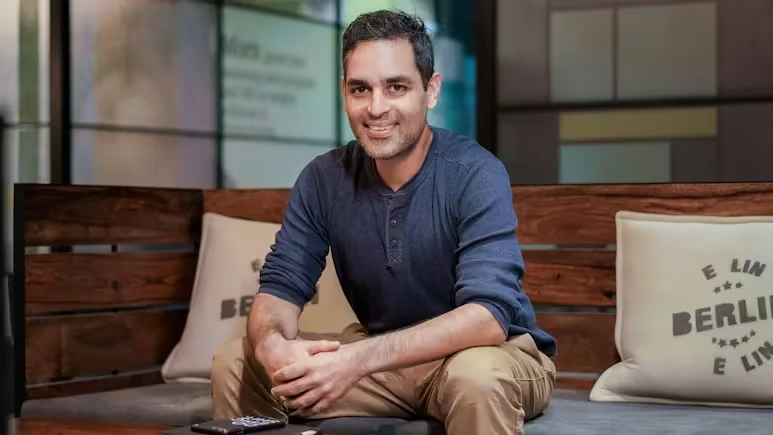 Ankur Warikoo Shares the Best Money Advice He Ever Got: Why Not All Money Feels the Same
 Alia Bhatt’s Love & War First Look Is Here: Retro Showgirl Avatar, Ranbir Kapoor Connection and Everything You Need to Know
 Shruti Haasan at 40: “What If Motherhood Is No Longer Possible?” Her PCOS Story Challenges a Common Fertility Myth
 Tamannaah Bhatia’s Madhubani Dupatta With Hand-Painted Radha-Krishna Is a Tribute to Bihar and The Vvaan
Hover to fan the frames
Your take
Was this worth your time?
0 reactions