On this page
In this story
- Table of Contents
- Alia Bhatt, Aryan Khan, Diljit Dosanjh, and Payal Kapadia Lead TIME100
- Frequently Asked Questions (FAQs)
Table of Contents
Alia Bhatt, Aryan Khan, Diljit Dosanjh, and Payal Kapadia Lead TIME100
On November 19, 2026, TIME magazine marked a watershed moment in global cultural recognition by unveiling the inaugural TIME100 Next India list—the very first international edition of its acclaimed TIME100 Next franchise. Designed to spotlight 100 emerging trailblazers shaping India’s trajectory across entertainment, business, science, sports, and advocacy, the debut edition placed Indian creative voices squarely on the global stage.
Leading the charge across three worldwide cover issues (slated for newsstands on December 7, 2026, ahead of an inaugural Mumbai gala at the Jio World Convention Centre on December 12) are Alia Bhatt, Aryan Khan, and Payal Kapadia (alongside Nagaland filmmaker Theja Rio and Skyroot Aerospace co-founder Pawan Kumar Chandana), joined inside the roster by global music and screen powerhouse Diljit Dosanjh. Yet beyond the prestige of the cover portraits and peer-written tributes, it was Alia Bhatt’s unflinching cover interview—addressing the box-office setbacks of Jigra and Alpha, double standards around female-led movies, and basic workplace dignity for women on film sets—that ignited the biggest conversation across Indian cinema.
Executive Snapshot: Why the Inaugural TIME100 Next India 2026 List Matters
- A Historic Global First: Launched on November 19, 2026, TIME100 Next India represents TIME’s first-ever country-specific international edition of the TIME100 Next platform, celebrating 100 rising leaders redefining India’s future across culture, enterprise, sport, and civic life.
- Three Worldwide Covers: Actor and producer Alia Bhatt headlines a solo global cover, Skyroot Aerospace CEO Pawan Kumar Chandana fronts a second cover, and a third group cover unites a new vanguard of Indian directors—Aryan Khan, Payal Kapadia, and Theja Rio.
- Alia Bhatt’s Stand on Women-Led Films: Addressing the commercial underperformance of her recent releases Jigra and Alpha, Bhatt pointed out that a single flop never leads anyone to question making “male-centric” movies, declaring: “I am not going to stop choosing films that are women-led.”
- Backing Fair Work Hours & Set Conditions: In the same conversation, Bhatt voiced support for Deepika Padukone’s push for reasonable eight-hour work shifts and called for fundamental workplace protections for women in Indian cinema, including clean washrooms and safer set infrastructure.
- Peer-Written Tributes Across Categories: The list pairs honourees with industry peers and icons—including S.S. Rajamouli writing on Alia Bhatt, Vishal Bhardwaj profiling Aryan Khan, and Shonali Bose penning the tribute for Payal Kapadia.
Part 1: Alia Bhatt’s Cover Story — Shattering Labels, Defending Women-Led Cinema, and Calling for Better Set Conditions
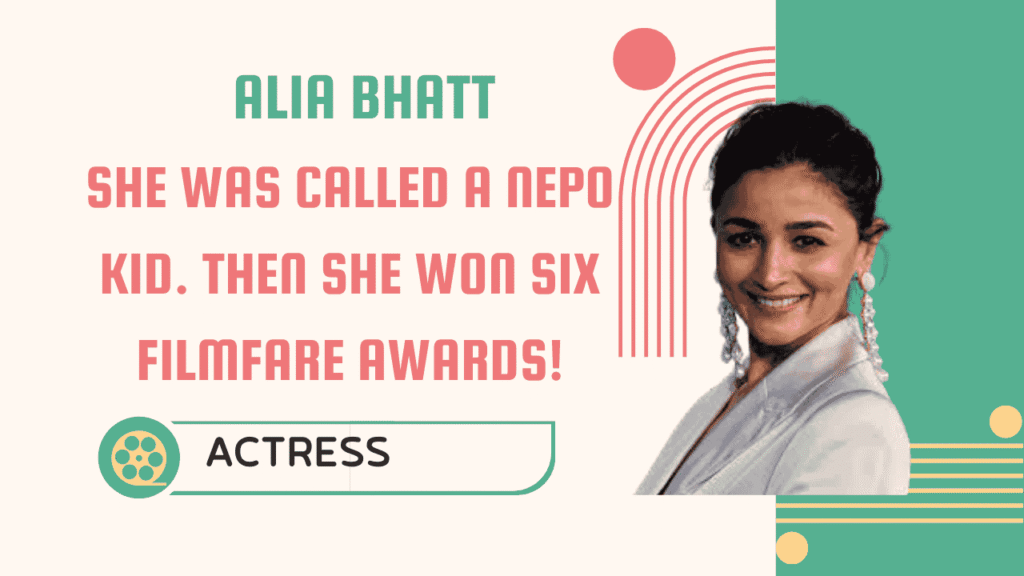
Positioned in the Artists category and profiled by RRR director S.S. Rajamouli, Alia Bhatt’s solo cover story serves as both a retrospective on a 14-year screen evolution and a candid manifesto on where Hindi cinema still falls short.
1. From “Pretty Girl” Stereotypes to Relentless Risk-Taking
Reflecting on her 2012 debut in Karan Johar’s Student of the Year, Bhatt recalled the narrow box early critics placed her in: “The perception about me was: pretty girl, dances well. Not much to offer, acting-wise.” Rather than coasting on commercial glamour, she pivoted sharply with Imtiaz Ali’s Highway (2014)—a role she said she “pounced” on to shatter preset expectations—followed by Udta Punjab (2016), Raazi, Dear Zindagi, and Sanjay Leela Bhansali’s Gangubai Kathiawadi.
In his TIME tribute, S.S. Rajamouli—who directed Bhatt as Sita in RRR—underscored why she commands global respect even in brief screen appearances:
“As a director, I watch how an actor listens. Alia listens with her whole being. That is rare, and it cannot be taught. She never takes the safe road. She takes the hard one and makes it look effortless. Indian cinema is finding its global voice, and Alia is one of the ambassadors carrying it forward.”
2. Pushing Back Against Box-Office Double Standards After Jigra and Alpha
The sharpest headline from Bhatt’s TIME interview came when she confronted the commercial disappointments of her recent female-fronted projects, Jigra and the action-thriller Alpha. Whenever a female-led tentpole stumbles at the Indian box office, trade commentary quickly questions the financial viability of women-centric cinema as an entire category.
Bhatt dismantled that double standard head-on:
“When a male-led film flops, nobody says that we shouldn’t be making ‘male-centric’ films. So I am not going to stop choosing films that are women-led. When you take these gambles, you always risk falling flat on your face. But there’s an equally good chance that you might fly.”
Her remarks struck a nerve across the entertainment industry because they framed risk-taking as a creative necessity rather than a gender-specific liability. Having already proven that female-led stories like Raazi and Gangubai Kathiawadi can deliver massive theatrical returns, Bhatt made clear that occasional commercial misses will not push her back into passive, decorative roles.
3. Backing Fair Working Hours and Basic Facilities on Sets
Beyond script selection, Bhatt used her TIME platform to address everyday working realities behind the camera. Expressing solidarity with Deepika Padukone’s widely debated advocacy for eight-hour work shifts for actors and crew—particularly working mothers—Bhatt highlighted that equity in film production starts with basic human infrastructure, including regulated schedules, safer working environments, and clean, accessible washrooms for women on location shoots.
Part 2: The Filmmakers’ Cover — Aryan Khan, Payal Kapadia, and Theja Rio
If Alia Bhatt’s cover represents the evolution of mainstream Indian stardom, TIME’s directors group cover—uniting Aryan Khan, Payal Kapadia, and Theja Rio under the Innovators category—captures the sheer stylistic breadth reshaping Indian storytelling in 2026.
Aryan Khan: Building a Multi-Hyphenate Creative Identity
Featured alongside Kapadia and Rio on TIME’s directors cover and profiled by acclaimed filmmaker Vishal Bhardwaj, Aryan Khan has steadily carved out his own path behind the camera rather than following the traditional Bollywood star-kid acting route. Recognized by TIME as both a filmmaker and entrepreneur, Khan stepped into the spotlight as a creator and director with his satirical streaming series The Ba*ds of Bollywood while simultaneously scaling his luxury lifestyle venture D’YAVOL. Having Vishal Bhardwaj—one of Indian cinema’s most literary and uncompromising auteurs—author his TIME profile signals serious creative credibility for his directorial voice.
Payal Kapadia: From Cannes History to Global Indie Vanguard
Few Indian filmmakers have altered international cinema’s perception of contemporary India as profoundly as Payal Kapadia. After making history as the first Indian director in three decades to compete in the main competition at Cannes—and winning the prestigious Grand Prix for her luminous Mumbai drama All We Imagine as Light—Kapadia’s inclusion on the TIME100 Next India cover cements her status as a defining global auteur. Profiled by director Shonali Bose (Margarita with a Straw, The Sky Is Pink), Kapadia represents a fearless, poetic school of independent Indian filmmaking that refuses to compromise nuance for formula.
Theja Rio: Bringing Nagaland’s Stories to the World
Rounding out the cover trio is Nagaland-born filmmaker Theja Rio (profiled by Assamese auteur Rima Das). Known for acclaimed works like Angh and Ade (On a Sunday), Rio’s spot on the global cover reflects TIME’s conscious effort to look beyond Mumbai and Chennai—recognizing how filmmakers from Northeast India are crafting intimate, deeply rooted cinema that resonates on international festival circuits.
Part 3: Diljit Dosanjh — Taking Punjabi Music and Culture From Stadiums to Global Pop Culture

Named in the Leaders category of TIME100 Next India 2026, Diljit Dosanjh stands as perhaps the purest embodiment of India’s borderless cultural export in the 2020s.
Over the past few years, Dosanjh has dismantled every conventional assumption about language barriers in global pop music and cinema:
- Historic Global Touring: From making history at Coachella and selling out massive stadium dates across North America, Europe, and Australia on his Dil-Luminati and Aura world tours to drawing tens of thousands of fans across Indian cities, Dosanjh proved that Punjabi music sung entirely in Gurmukhi-rooted lyrics can command mainstream global arenas.
- Screen Versatility: Alongside his chart-topping discography, his nuanced dramatic performances—most notably in Imtiaz Ali’s Amar Singh Chamkila—earned widespread critical acclaim, proving he balances stadium-scale charisma with deeply empathetic acting.
- Cultural Authenticity Without Dilution: Whether stepping onto international late-night television or global red carpets in traditional Punjabi attire and turban, Dosanjh’s rise demonstrates that Indian artists no longer need to Westernize their identity to achieve worldwide stardom.
Part 4: Who Else Made the Inaugural TIME100 Next India 2026 List?
While Alia Bhatt, Aryan Khan, Payal Kapadia, and Diljit Dosanjh led the entertainment headlines, the inaugural 100-person list spans five core pillars—Artists, Phenoms, Innovators, Leaders, and Advocates—bringing together cinema, music, sports, aerospace, and social change:
| Category / Domain | Notable 2026 Honourees & Peer Tributes | Key Impact & Cultural Footprint |
| Cinema & Acting | Alia Bhatt (by S.S. Rajamouli), Vicky Kaushal (by Alia Bhatt), Sai Pallavi (by Gautham Ramachandran), Samantha Ruth Prabhu (by Manoj Bajpayee), Taapsee Pannu (by Anubhav Sinha), Triptii Dimri (by Mozez Singh), Nayanthara (by Vishnu Varadhan), Jitendra Kumar (by Neena Gupta), Kani Kusruti, Parvathy Thiruvothu, Vedang Raina, Ali Fazal, Dulquer Salmaan | Reflects a pan-Indian screen landscape where Malayalam, Tamil, Telugu, and Hindi performers shape national and international cinema alike. |
| Filmmaking & Direction | Aryan Khan (by Vishal Bhardwaj), Payal Kapadia (by Shonali Bose), Theja Rio (by Rima Das), Anuparna Roy | Celebrates a new generation of Indian directors spanning streaming satire, Cannes-winning art cinema, and regional storytelling. |
| Music & Live Culture | Diljit Dosanjh, Anirudh Ravichander (by Allu Arjun), Faheem Abdullah (by A.R. Rahman), Jasleen Royal (by Qaran), Prateek Kuhad, Arivu, Ishaan Ghosh, Saniya MQ | Highlights how Indian composers, indie singer-songwriters, and hip-hop artists dominate global streaming charts and stadium tours. |
| Fashion & Culinary Arts | Masaba Gupta, Diya Joukani (by Bandana Tewari), Chintan Pandya (by Padma Lakshmi), Prateek Sadhu | Recognizes Indian designers and chefs redefining contemporary luxury and gastronomy worldwide. |
| Science, Business & Space | Pawan Kumar Chandana (Skyroot Aerospace, by Rajan Anandan), Shubhanshu Shukla (Astronaut), Albinder Singh Dhindsa, Peyush Bansal, Radhika Gupta, Tarun Mehta | Spotlights India’s deep-tech, private spaceflight, consumer tech, and financial-inclusion pioneers. |
| Sports & Advocacy | Harmanpreet Kaur, Sania Mirza, Lovlina Borgohain, Savita Punia, Vaibhav Sooryavanshi (by Ayushmann Khurrana), Grace Banu, Shaheen Malik, Kuldeep Dantewadia | Honours athletic excellence—from cricket prodigies to Olympic medallists—alongside grassroots social changemakers. |
Part 5: What Comes Next — The December 12 Mumbai Gala & The Bigger Shift in Indian Pop Culture
The TIME100 Next India 2026 rollout culminates on December 12, 2026, when TIME and Reliance host the inaugural TIME100 Next India Gala at Mumbai’s Jio World Convention Centre, bringing together cover stars Alia Bhatt, Aryan Khan, Payal Kapadia, Theja Rio, and Pawan Kumar Chandana alongside a special musical performance by Kashmiri singer-songwriter Faheem Abdullah.
Taken together, the inaugural roster sends an unmistakable message about Indian entertainment in 2026:
- Language & Geography No Longer Define Reach: Whether it is Diljit Dosanjh singing in Punjabi, Anirudh Ravichander scoring pan-Indian blockbusters, Payal Kapadia filming in Mumbai, or Theja Rio telling stories from Nagaland, global cultural influence flows from every corner of India.
- Women Are Setting the Creative & Workplace Agenda: With Alia Bhatt, Sai Pallavi, Samantha Ruth Prabhu, Taapsee Pannu, Nayanthara, Kani Kusruti, Parvathy Thiruvothu, and Payal Kapadia prominently honoured—and Bhatt openly challenging box-office double standards and demanding safer set conditions—female artists are actively reshaping industry norms rather than waiting for permission.
- A New Generation of Directors Has Arrived: Placing Aryan Khan, Payal Kapadia, and Theja Rio together on a global cover signals that the next decade of Indian cinema belongs to bold authorial voices willing to take creative risks.
Frequently Asked Questions (FAQs)
Who featured on the covers of the inaugural TIME100 Next India 2026 list? TIME unveiled three worldwide covers for its inaugural TIME100 Next India edition: a solo cover featuring Alia Bhatt, a solo cover featuring Skyroot Aerospace co-founder Pawan Kumar Chandana, and a group cover featuring directors Aryan Khan, Payal Kapadia, and Theja Rio.
What did Alia Bhatt say about women-led films in her TIME100 Next India interview?Addressing the box-office failures of Jigra and Alpha, Alia Bhatt pointed out that nobody questions making “male-centric” movies when a male-led film flops, adding: “So I am not going to stop choosing films that are women-led. When you take these gambles, you always risk falling flat on your face. But there’s an equally good chance that you might fly.”
Who wrote the TIME100 Next India tributes for Alia Bhatt, Aryan Khan, and Payal Kapadia? Filmmaker S.S. Rajamouli penned the tribute for Alia Bhatt, director Vishal Bhardwaj wrote the profile for Aryan Khan, and filmmaker Shonali Bose wrote the tribute for Payal Kapadia.
When and where is the TIME100 Next India 2026 Gala taking place?The inaugural TIME100 Next India Gala is scheduled for December 12, 2026, at the Jio World Convention Centre in Mumbai, following the global print release of the issue on December 7, 2026.
In frames · the Bollywood desk
 The 100 Most Influential People of 2026: Alia Bhatt, Aryan Khan, Diljit Dosanjh, and Payal Kapadia Lead TIME100
 Avengers: Doomsday Shatters Records as India Advance Bookings Cross ₹50 Crore Ahead of Release
 Salman Khan Confirms Dabangg 4, Rules Out Bajrangi Bhaijaan 2, and Apologizes to Shraddha Kapoor Over Maatrubhumi–Eetha Clash
 Dia Mirza Indian Actress, Film Producer, Former Beauty Queen & Global Environmental Advocate
Hover to fan the frames
Your take
Was this worth your time?
0 reactions