On this page
- Table of Contents
- Ankle Sprains in Sport
- What Happens Inside Your Ankle During a Sprain
- Why Some Sprains Are Worse Than Others
- Why the Same Ankle Keeps Getting Sprained
- The First 48 to 72 Hours: What to Do Immediately
- When to See a Doctor Instead of Self-Managing
- The Rehabilitation Progression: Four Phases That Actually Work
- Phase One: Pain Control and Early Movement
- Phase Two: Restoring Range of Motion and Basic Strength
- Phase Three: Building Strength, Balance, and Control
- Phase Four: Sport-Specific Preparation and Return to Play
- The Criteria That Actually Determine Readiness to Return
- Prevention: How to Make Sure It Does Not Happen Again
- The Mental Side of Ankle Sprains
- A Final Word on Doing It Right the First Time
- Frequently Asked Questions
In this story
- Table of Contents
- Ankle Sprains in Sport
- What Happens Inside Your Ankle During a Sprain
- Why Some Sprains Are Worse Than Others
- Why the Same Ankle Keeps Getting Sprained
Table of Contents
Ankle Sprains in Sport
You rolled your ankle during a game, felt a sharp pull on the outside of your foot, and for a second you were not sure whether you could stand. Then the swelling started. By the next morning, the ankle was stiff, tender, and visibly puffy — and now you are wondering whether you should rest it, ice it, tape it, or see someone. Most athletes make their first mistake right here, by treating every ankle sprain as if it were the same injury.
An ankle sprain is one of the most common injuries in sport, yet it is also one of the most poorly managed. Many people rest it for a few days, wait for the pain to fade, and return to training without ever rebuilding the balance, strength, and control that the injury took away. That is why the same ankle keeps getting sprained. This guide explains exactly what happens inside the ankle during a sprain, how to manage the first few days, how rehabilitation should progress, and what return to sport should look like if you want to avoid repeating the injury.
What Happens Inside Your Ankle During a Sprain
Your ankle is not a single joint. It is a group of joints and bones held together by a network of ligaments — strong, slightly elastic bands of tissue that connect bone to bone and keep the joint stable while allowing controlled movement. When you land, cut, change direction, or step on an uneven surface, these ligaments absorb and control forces that would otherwise send your foot in the wrong direction.
A sprain occurs when one of these ligaments is stretched beyond its normal capacity. In the most common type of ankle sprain, the foot rolls inward while the outer side of the ankle is forced to take the load. The ligaments on the outside of the ankle — particularly the anterior talofibular ligament — get overstretched or torn. This is called an inversion sprain, and it is by far the most frequent type seen in sport.
The moment the ligament is overstretched, tiny blood vessels in the area rupture. That is why swelling and bruising appear so quickly. The body sends fluid and inflammatory cells to the injured area to begin repair, which is why the ankle becomes puffy, warm, and stiff within hours. The pain you feel is not just from the torn ligament itself — it is also from the pressure created by swelling inside a joint that has very little room to expand.
Why Some Sprains Are Worse Than Others
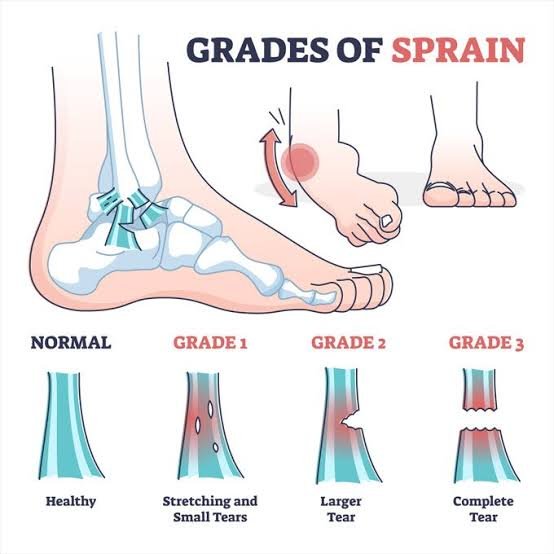
Not all ankle sprains are equal, and treating a mild sprain the same way as a severe one — or the other way around — is where recovery goes wrong. Sprains are classified into three grades based on how much damage the ligament has taken.
A Grade I sprain is the mildest form. The ligament has been stretched but not torn, or there may be only microscopic fiber damage. You will feel tenderness, mild swelling, and discomfort when you move the ankle, but you can usually still bear weight and walk with some discomfort. Recovery is typically faster, often within one to three weeks with proper management.
A Grade II sprain involves a partial tear of the ligament. The pain is more intense, swelling is more noticeable, bruising often appears within a day or two, and there may be some looseness or instability in the joint. Walking becomes difficult, and the ankle feels weak or unreliable when you try to push off it. Recovery takes longer, usually four to six weeks, and requires more structured rehabilitation to restore full function.
A Grade III sprain is a complete tear or rupture of the ligament. This is the most severe form and comes with significant swelling, bruising, instability, and often an inability to bear weight at all. The ankle feels loose and unreliable, and in some cases surgical evaluation is needed depending on the extent of the damage and the athlete’s activity level. Recovery from a Grade III sprain can take several months, and the rehabilitation process is much more involved.
Why the Same Ankle Keeps Getting Sprained
This is the question that frustrates athletes the most. You sprain your ankle, it heals, you feel fine, and then a few months later — sometimes during something as simple as stepping off a curb — it happens again. The reason is almost always the same: the injury was treated as a pain problem rather than a stability problem.
When a ligament is sprained, it does not just heal back to its original strength automatically. The healing tissue is often less elastic, less responsive, and less coordinated than it was before the injury. More importantly, the small muscles and nerve receptors around the ankle that control balance and joint position — called proprioceptors — get disrupted during the injury. These are the sensors that tell your brain where your foot is in space without you having to look at it. When they are damaged or desensitized, your reaction time to a sudden twist or uneven landing is slower, and the ankle is more likely to roll again before you can correct it.
This is why simply resting until the pain goes away is not enough. The pain may be gone, but the balance deficit, the strength deficit, and the neuromuscular control deficit are still there. Until those are specifically retrained, the ankle remains vulnerable. This is the core reason re-sprain rates are so high in athletes who do not complete a proper rehabilitation program.
The First 48 to 72 Hours: What to Do Immediately
The first few days after a sprain set the tone for the entire recovery. What you do in this window determines how much swelling develops, how quickly pain settles, and how well the tissue begins to repair.
In the immediate phase, the priority is protecting the ankle from further damage while managing swelling and pain. Elevate the ankle above heart level as often as possible — this uses gravity to help drain the excess fluid that is building up. Apply a compression bandage snugly but not tightly enough to cause numbness or discoloration in the toes. Use ice wrapped in a cloth, applied for 15 to 20 minutes at a time with at least 45 minutes between applications, to reduce pain and limit the inflammatory response in the very early phase.
Avoid anti-inflammatory medication in the first 48 hours if possible. This may sound counterintuitive, but inflammation is not the enemy in the early phase — it is part of the repair process. Suppressing it too aggressively can slow tissue healing. Once the acute inflammatory phase has passed, usually beyond 72 hours, anti-inflammatory options become more appropriate if pain is still limiting function.
Do not attempt to “walk it off” or test the ankle by putting full weight on it if it feels unstable. Protecting the joint in the first few days is not weakness — it is giving the ligament the environment it needs to begin healing without being re-torn.
When to See a Doctor Instead of Self-Managing
Most Grade I and some Grade II sprains can be managed conservatively at home with a structured plan. But there are clear situations where professional assessment is non-negotiable.
If you cannot bear any weight on the foot within 24 hours of the injury, if there is visible deformity, if the swelling is extreme and rapid, if there is numbness or tingling in the toes, or if the pain feels like it is coming from the bone rather than the soft tissue — get it assessed. An X-ray may be needed to rule out a fracture, particularly if there is point tenderness directly on a bone. The Ottawa ankle rules, a widely used clinical screening tool, help clinicians decide when imaging is necessary based on specific pain locations and weight-bearing ability.
A high ankle sprain — an injury to the ligaments connecting the two bones of the lower leg above the ankle — is a different and more serious category that requires different management and a longer recovery timeline. If the pain is higher up the leg, above the ankle bone rather than on the outer side of the ankle itself, this needs specific evaluation.
The Rehabilitation Progression: Four Phases That Actually Work
Rehabilitation is where most ankle sprains either succeed or fail. The athletes who return to sport without re-injury are the ones who follow a structured, progressive plan rather than simply waiting for pain to disappear. Rehabilitation moves through distinct phases, each with a specific goal.
Phase One: Pain Control and Early Movement
The first phase, typically the first week or so, focuses on reducing swelling, managing pain, and restoring basic range of motion. Gentle ankle movements — tracing the alphabet with your foot, gently moving the ankle up and down and side to side within a comfortable range — begin reactivating the joint without stressing the healing ligament. Weight-bearing is introduced gradually as tolerated, often starting with partial weight-bearing using crutches or a walking boot if needed, and progressing to full weight-bearing as pain allows.
The goal in this phase is not to push through pain. It is to keep the joint moving enough to prevent stiffness from setting in, while giving the ligament the protected environment it needs to start repairing.
Phase Two: Restoring Range of Motion and Basic Strength
Once the acute swelling has settled and basic movement is comfortable, the focus shifts to restoring full range of motion and beginning targeted strengthening. Calf raises, resistance band exercises in all directions, and gentle stretching of the calf and Achilles complex are the foundation here. The calf muscles and the muscles that stabilize the ankle work together, and weakness in one group creates compensation patterns that load the ankle unevenly.
This phase also introduces balance work in its simplest form — single-leg standing, first on a stable surface, then progressing to slightly unstable surfaces like a folded towel or balance pad. This is where the proprioceptive retraining begins, and it is the most important part of the entire rehabilitation process for preventing re-injury.
Phase Three: Building Strength, Balance, and Control
This is the phase most athletes skip, and it is the phase that determines whether the ankle comes back stronger or stays vulnerable. The focus here is on progressive loading — calf raises on a step, single-leg balance with eyes closed, resistance band work in multiple directions, and eventually light plyometric work like small hops and jumps.
Balance training on unstable surfaces — a wobble board, balance disc, or even a folded towel — forces the small stabilizing muscles around the ankle to react and adjust constantly. This is exactly the kind of training that rebuilds the proprioceptive system that was disrupted during the injury. Research consistently shows that structured balance and neuromuscular training programs significantly reduce the risk of recurrent ankle sprains compared to rest alone.
Strength work in this phase should target not just the ankle itself but the entire chain — glutes, hamstrings, quads, and core — because ankle stability is not just an ankle problem. A weak hip or poor core control changes how forces travel through the leg and can overload the ankle during dynamic movement.
Phase Four: Sport-Specific Preparation and Return to Play
The final phase bridges the gap between rehabilitation and actual competition. This is where the exercises become sport-specific — agility drills, change-of-direction work, single-leg hops in multiple directions, box jumps, sprinting, shuffling, and reaction-based movements that mimic the demands of the actual sport.
The goal here is not just to make the ankle strong in a straight line. It is to make it resilient under the unpredictable, multi-directional forces that sport actually produces. A footballer needs to be able to cut and change direction. A badminton player needs to lunge and pivot. A runner needs to handle uneven terrain. The rehabilitation must match the demands of the sport, not just the injury.
Return to sport should be gradual — starting with controlled practice drills, then progressing to full-speed training, then to competitive play. The ankle should feel stable, strong, and confident before full return, not just pain-free.
The Criteria That Actually Determine Readiness to Return
Pain going away is not the same as being ready to return. Many athletes return too early because the pain has stopped, only to re-injure the ankle because the underlying strength, balance, and control deficits were never fully addressed.
Objective criteria for return to sport include full or near-full range of motion, strength in the injured ankle that is at least 90 percent of the uninjured side, balance and proprioceptive performance that matches the uninjured side, and the ability to perform sport-specific movements — hopping, cutting, jumping, landing — without pain, swelling, or compensation. Functional hop tests, where the athlete performs single-leg and multi-directional hops and the distance is compared between the injured and uninjured leg, are a practical way to measure readiness objectively rather than relying on how the ankle feels.
The athlete’s own confidence matters too. Fear of re-injury is real and measurable, and an athlete who does not trust the ankle will move differently, compensate, and remain at higher risk even if the physical structures have healed.
Prevention: How to Make Sure It Does Not Happen Again
Preventing re-injury is not about wearing a brace forever or avoiding sport. It is about building a body that can handle the demands you place on it.
Consistent balance and proprioceptive training — even after full return to sport — is the single most effective prevention strategy. A few minutes of single-leg balance work, wobble board training, or reaction-based drills a few times a week maintains the neuromuscular control that protects the ankle. Strength training that targets the calves, glutes, and hip stabilizers supports the ankle indirectly by improving overall lower limb mechanics.
Proper footwear matters. Shoes that are worn out, do not fit correctly, or do not provide adequate support for the specific sport increase ankle vulnerability. For athletes with a history of recurrent sprains, an ankle brace or taping during high-risk activity can provide additional external support while the internal stability is being rebuilt — though this should be seen as a supplement to rehabilitation, not a replacement for it.
Training load management is the other major factor. Spikes in training volume or intensity, especially after a period of reduced activity, are a common trigger for re-injury. Building load progressively, with adequate recovery between sessions, keeps the tissue adapting rather than breaking down.
The Mental Side of Ankle Sprains
Fear of re-injury is one of the biggest hidden barriers to full recovery. Many athletes return to sport physically healed but mentally hesitant, moving differently, avoiding certain movements, and unconsciously protecting the ankle in ways that create new problems elsewhere.
Gradual exposure to sport-specific movements during rehabilitation — starting with controlled drills and progressing to full-speed, unpredictable play — rebuilds confidence alongside physical capacity. Working with a sports psychologist or simply talking through the fear with a coach or physiotherapist can help. Acknowledging the mental dimension of injury is part of complete care, not a sign of weakness.
A Final Word on Doing It Right the First Time
The difference between an ankle that keeps getting sprained and one that comes back stronger is almost always the quality of the rehabilitation that followed the first injury. Athletes who treat a sprain as a full-body, multi-phase process — addressing swelling, restoring range of motion, rebuilding strength and balance, and progressing to sport-specific demands — come back more resilient than they were before.
Athletes who rest until the pain fades and then jump straight back into full training are the ones who end up in a cycle of repeated injury. The choice is yours, and it is made in the weeks and months after the injury, not in the moment it happens.
Frequently Asked Questions
How long does an ankle sprain take to heal?
It depends entirely on the grade. A Grade I sprain typically heals within one to three weeks. A Grade II sprain takes four to six weeks with proper rehabilitation. A Grade III sprain can take three to six months or longer, especially if surgery is involved. The key variable is not just time but whether a structured rehabilitation program was followed — athletes who complete full rehab return to sport with lower re-injury rates.
Should I walk on a sprained ankle?
In the first 24 to 48 hours, if weight-bearing is painful or the ankle feels unstable, avoid putting full weight on it. Use crutches or a walking boot if needed. As pain and swelling settle, gradual weight-bearing is actually encouraged because it stimulates healing and prevents stiffness. The rule is progressive loading, not complete rest or immediate full activity.
Is ice or heat better for a sprained ankle?
Ice is better in the first 48 to 72 hours after the injury because it reduces pain and limits swelling. Apply it wrapped in a cloth for 15 to 20 minutes at a time. After the acute phase passes, heat becomes more useful for relaxing stiff muscles and improving circulation during the healing phase. Using heat too early increases blood flow to an already inflamed area and can worsen swelling.
Why does my ankle keep getting sprained?
Recurrent sprains almost always come down to incomplete rehabilitation. The ligament may have healed, but the balance, proprioception, and neuromuscular control that protect the ankle were never fully retrained. Without targeted balance and strength work, the ankle remains vulnerable to the same twisting forces that caused the original injury.
Do I need an X-ray for an ankle sprain?
Not always. X-rays are typically recommended when there is point tenderness directly on a bone, inability to bear weight, significant swelling, or visible deformity. The Ottawa ankle rules help clinicians decide when imaging is necessary. If your pain is focused on the soft tissue on the outside of the ankle rather than directly on a bone, and you can bear some weight, an X-ray may not be needed — but a clinical assessment is still worthwhile for Grade II and III sprains.
Can I prevent ankle sprains from happening again?
Yes, and the most effective approach is consistent balance and proprioceptive training even after full return to sport. A few minutes of single-leg balance work, wobble board training, or reaction-based drills a few times a week maintains the neuromuscular control that protects the ankle. Strength training for the calves, glutes, and hips, proper footwear, and progressive training load management all reduce re-injury risk significantly.
When is surgery needed for an ankle sprain?
Surgery is rarely needed for routine ankle sprains, even Grade III ones. Most complete ligament tears heal well with structured rehabilitation. Surgery becomes a consideration when there is chronic instability that does not respond to rehabilitation, significant structural damage, or in cases of high ankle sprains with syndesmotic involvement. The decision depends on the specific injury, the athlete’s activity level, and the response to conservative treatment.
Is it normal for my ankle to feel weak months after a sprain?
It is common, but it is not something to accept as permanent. Persistent weakness or instability months after a sprain usually means the rehabilitation was incomplete — specifically the balance and proprioceptive retraining phase was skipped or rushed. A physiotherapist can assess where the deficit is and design a targeted program to restore full function. Persistent instability that does not improve with rehabilitation may need further evaluation.
In frames · the Sports Injury desk
 Ankle Sprains in Sport: The Complete Recovery Guide From Day One to Return to Play
 Your Body is Talking — Are You Listening? Common Athlete Injuries
 Osgood-Schlatter Disease in Teenage Athletes: Knee Growth Plate Pain and Activity Management Guide
 Peroneal Tendonitis vs. Peroneal Tear: How Runners Can Tell the Difference
Hover to fan the frames
Your take
Was this worth your time?
0 reactions