On this page
- Table of Contents
- Common Athlete Injuries
- First, What Even Is a Sports Injury
- Sprains: When a Joint Goes Too Far
- Strains: The Muscle Pull You Feel Mid-Sprint
- Fractures: Broken Bones Are Not Always Obvious
- Dislocations: When a Joint Steps Out of Place
- Knee Injuries: The Most Common Category in Sport
- Shin Splints: The Runner’s Constant Companion
- Tendinitis: When Repetition Becomes Damage
- Concussions: More Serious Than Most People Realize
- What to Do the Moment an Injury Happens
- Why Some People Get Injured More Than Others
- The Difference Between Soreness and Injury
- Frequently Asked Questions
In this story
- Table of Contents
- Common Athlete Injuries
- First, What Even Is a Sports Injury
- Sprains: When a Joint Goes Too Far
- Strains: The Muscle Pull You Feel Mid-Sprint
Table of Contents
Common Athlete Injuries
You do not have to be a professional footballer or an Olympic sprinter to get injured. A weekend badminton game, a morning jog around the park, or a gym session with a little too much enthusiasm — any of these can result in the kind of injury that sidelines you for days, weeks, or longer. The frustrating part is that most people have no idea what actually happened inside their body when they got hurt, which makes it almost impossible to know what to do next.
This guide explains the most common athlete injuries in plain language — no medical jargon, no confusing anatomy diagrams. Just clear, honest information about what each injury is, why it happens, what it feels like, and what you should do about it.
First, What Even Is a Sports Injury
A sports injury is any physical damage that happens to your body while you are playing a sport, training, exercising, or doing any kind of physical activity. It can affect your muscles, bones, joints, tendons, or ligaments — the various structures that allow your body to move.
The important thing to understand upfront is that sports injuries fall into two broad categories. Acute injuries are the ones that happen in a single moment — you land badly, you twist your ankle, you take a knock. You usually know the exact second they happened. Chronic injuries are the slow-burn kind — they develop over time from doing the same movement repeatedly without giving your body enough recovery. Both are real injuries. Both deserve proper attention.
Sprains: When a Joint Goes Too Far
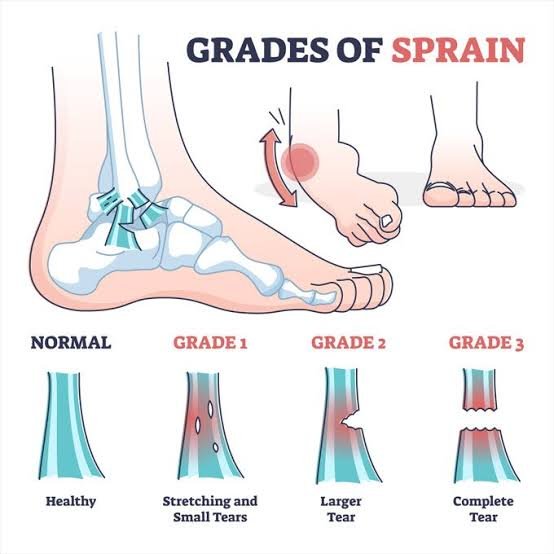
A sprain happens when a ligament — the tough band of tissue that connects one bone to another inside a joint — gets stretched or torn beyond its normal range. Your ankle, knee, and wrist are the most commonly sprained joints because they take enormous rotational forces during sport.
The classic sprain scenario is a rolled ankle. You plant your foot at the wrong angle, the ankle folds inward, and you feel an immediate sharp pain followed by swelling and tenderness. Grade I sprains are mild — the ligament is stretched but not torn, and most people are back to activity within a couple of weeks. Grade II sprains involve a partial tear and can take four to six weeks. Grade III sprains are a complete rupture of the ligament — these can sometimes be more complicated to manage than a clean fracture and require several months of rehabilitation.
The key signal that separates a sprain from just “turning your ankle” is swelling that develops within the first hour and pain that makes weight-bearing difficult. If either of those is present, treat it seriously.
Strains: The Muscle Pull You Feel Mid-Sprint
A strain affects the muscle itself or the tendon that attaches muscle to bone. It happens when a muscle is suddenly forced to contract more powerfully than it can handle, or when it is overstretched beyond its elastic limit. Hamstring strains during sprinting, calf strains during a sudden push-off, and lower back strains from poor lifting technique are among the most frequent injuries in sport at every level.
The sensation is usually a sharp, grabbing pain — sometimes described as feeling like something snapped or was kicked from the inside. Swelling and bruising can follow over the next 24 hours, and the muscle will feel weak and tender to touch. Mild strains recover within two to three weeks. More significant tears in a major muscle group like the hamstring can take two to three months, and rushing back before the tissue has fully healed is the most common reason for re-injury.
Fractures: Broken Bones Are Not Always Obvious
Most people imagine a fracture as a dramatic event — a bone visibly out of place, a fall from a height, an inability to move at all. While that describes severe fractures, the reality is that many fractures in sport are far subtler. A stress fracture, for example, can feel like nothing more than a persistent ache along your shin or foot that gets worse during activity and eases with rest.
A stress fracture is the result of repetitive loading on a bone that never fully recovers between sessions. Runners are the most commonly affected group, particularly in the shins, feet, and hips. The pain typically builds gradually over weeks, which is exactly why so many athletes mistake it for muscle soreness and keep training — often making the situation significantly worse.
Traumatic fractures from a direct impact or fall are easier to identify. There is immediate intense pain, often swelling, and frequently an inability to use the affected limb normally. One important myth to correct: being able to move a joint does not rule out a fracture. If there is point tenderness directly on a bone after an injury, get it checked with imaging.
Dislocations: When a Joint Steps Out of Place
A dislocation is exactly what it sounds like — the bones that form a joint are forced out of their normal alignment. The shoulder is by far the most commonly dislocated joint in sport, followed by fingers, kneecaps, and elbows. Contact sports like football, rugby, and wrestling carry the highest risk, though dislocations can happen in falls and awkward landings in any activity.
The appearance of a dislocated joint is distinctive — there is visible deformity, and the athlete usually feels immediate, intense pain combined with an inability to move the joint normally. It is critical that a dislocation is not treated on the field by teammates or coaches attempting to “pop it back in.” Forcing a joint back into position without proper assessment can damage surrounding blood vessels, nerves, and ligaments. This requires medical attention.
Knee Injuries: The Most Common Category in Sport
The knee is the joint most frequently injured across all sports and fitness activities. It is a complex structure involving bones, cartilage, multiple ligaments, and fluid-filled sacs — all working in precise coordination. When any of these elements is disrupted, the result ranges from mildly inconvenient to completely season-ending.
ACL tears are the most serious and most discussed knee injury in sport. The ACL (anterior cruciate ligament) is one of the key stabilizing ligaments inside the knee. It is most commonly torn during a sudden change of direction, a poor landing from a jump, or a direct blow to the knee. The injury often produces a popping sensation at the moment of occurrence, followed by rapid swelling and a feeling that the knee “gave way.” ACL tears in active people almost always require surgical reconstruction and several months of intensive rehabilitation.
Meniscus tears, patellar tendinitis, and runner’s knee (patellofemoral pain syndrome) are less dramatic but extremely common knee conditions. Meniscus tears often result from twisting the knee under load — something that happens constantly in football, basketball, and squash. Patellar tendinitis, sometimes called jumper’s knee, is an overuse condition affecting the tendon just below the kneecap. It is recognizable by a sharp ache at the front of the knee that worsens when climbing stairs, squatting, or jumping.
Shin Splints: The Runner’s Constant Companion
Shin splints is the common name for medial tibial stress syndrome — pain that runs along the inner edge of the shinbone. It is one of the most widespread overuse injuries in running, dancing, military training, and any activity involving sustained running on hard surfaces.
The pain is typically a diffuse ache rather than a sharp point of pain. It appears during or after activity, feels tender when you press along the shin, and has a pattern of easing with rest and returning when training resumes. The cause is almost always a combination of training load that increased too quickly, insufficient footwear, or biomechanical factors like overpronation. Importantly, shin splints that are ignored and trained through can progress to stress fractures — which is a significantly more serious problem with a much longer recovery.
Tendinitis: When Repetition Becomes Damage
Tendinitis refers to inflammation of a tendon — the cord-like tissue that connects your muscles to your bones. It develops from repetitive use of the same movement pattern without adequate rest. Common locations include the Achilles tendon at the back of the heel (particularly in runners), the patellar tendon below the kneecap, and the tendons of the elbow in racket sport players.
Tennis elbow (lateral epicondylitis) and golfer’s elbow (medial epicondylitis) are both forms of tendinitis at the elbow, and despite their names, they affect far more non-tennis and non-golf players than the sports they are named after. Anyone who performs repetitive gripping, lifting, or wrist extension — including badminton players, carpenters, and desk workers who also train — can develop these conditions. The hallmark is a burning or aching pain on the outer or inner elbow that worsens during and after activity and can make even simple tasks like holding a cup uncomfortable.
Concussions: More Serious Than Most People Realize
A concussion is a brain injury. It happens when the head receives a blow or jolt — or when the body is hit hard enough to cause the head to snap rapidly — which causes the brain to move inside the skull. In contact sports like football, hockey, boxing, and rugby, concussions are a genuine and well-documented concern at every level of play.
What catches most athletes off guard is that a concussion does not require a loss of consciousness. The majority of concussions involve no blackout at all. Symptoms include headache, nausea, dizziness, blurred vision, sensitivity to light or noise, difficulty concentrating, and a general feeling of mental fogginess or slowed thinking. These symptoms can appear immediately or be delayed for up to 24 to 36 hours after the incident.
The rule with concussions is simple and non-negotiable: any athlete suspected of having a concussion must be removed from play immediately and assessed by a medical professional before returning. The reason is second-impact syndrome — a condition where a second concussion received before the brain has fully recovered from the first can cause catastrophic, sometimes fatal, swelling of the brain. There is no score, no game, and no training session worth that risk.
What to Do the Moment an Injury Happens
The first few minutes and hours after an injury matter significantly. Continuing to play through sharp pain, instability, or loss of function is one of the most reliable ways to turn a manageable injury into a serious one. Stop, assess honestly, and act accordingly.
For most soft tissue injuries in the immediate phase, the current guidance is captured in the PEACE framework: Protect the injured area from further stress, Elevate it above heart level to reduce swelling, Avoid anti-inflammatory medications in the very early phase because inflammation is part of the natural healing process, Compress the area with a bandage for support, and Educate yourself on the realistic recovery timeline. After the first two to three days, the focus shifts to gradually reintroducing gentle load and movement — not prolonged immobilization.
See a doctor without delay if there is visible deformity, extreme swelling within the first hour, inability to bear weight after 24 hours, numbness or tingling, a suspected head injury, or any situation where the pain feels genuinely different from ordinary soreness.
Why Some People Get Injured More Than Others
Injury risk is not random. Athletes who skip warm-ups, increase their training volume too quickly, train in worn-out footwear, have muscle imbalances they have never addressed, or consistently undervalue sleep and recovery get injured more often. These are all modifiable factors — meaning they can be changed.
The athletes who stay consistently healthy over long periods are not necessarily the most talented or the most physically gifted. They are the ones who take warm-up seriously, build their training load incrementally, listen to what their body is communicating, and address small warning signals before they become injuries. That discipline, applied consistently, is the real difference between an athletic career defined by sustained performance and one defined by repeated time off.
The Difference Between Soreness and Injury
One of the most practically useful things a beginner athlete can learn is how to distinguish normal training soreness from genuine injury. Delayed onset muscle soreness — the aching, heavy feeling in muscles 24 to 48 hours after a hard session — is a normal and expected response to physical training. It is diffuse (spread across a muscle group rather than pinpointed), symmetrical (both legs or both arms), and it improves with gentle movement and resolves completely within 72 hours.
An injury, by contrast, tends to be sharp rather than achy, localized to a specific point rather than spread across a region, present during movement rather than just afterward, and does not improve with gentle activity. Pain that makes you change the way you move — limping, favouring one side, avoiding a particular direction — is always a signal that something needs attention. The body compensates around pain instinctively, and those compensations load adjacent structures in ways that create secondary injuries if left unaddressed.
Frequently Asked Questions
What is the most common injury for beginners who just started a sport?
Beginner athletes most commonly experience ankle sprains, knee pain, and shin splints. These injuries are frequently caused by a combination of unfamiliar movement patterns, inadequate footwear, and training load that increases faster than the body can adapt to. The best protection is a gradual build-up in training intensity, proper footwear fitted for the specific sport, and not skipping warm-up.
Can a sports injury heal on its own without treatment?
Minor Grade I sprains and mild muscle strains often heal without formal medical treatment, provided the athlete rests appropriately, manages swelling in the early phase, and returns to activity gradually. However, injuries involving fractures, significant ligament tears, dislocations, or any head injury cannot and should not be self-managed. Even for minor injuries, seeing a physiotherapist helps ensure the tissue heals correctly and reduces the likelihood of re-injury.
How do I know if my pain is normal soreness or something serious?
Normal muscle soreness after training is diffuse, affects a broad area, appears 24 to 48 hours after the session, and improves with gentle movement within two to three days. Injury pain is typically sharp, localized to a specific point, present during activity rather than just afterward, and does not follow the 48-72 hour recovery pattern. If pain changes the way you move, persists beyond a week, or comes with swelling, bruising, or instability — it needs assessment.
Is it safe to apply ice directly to a sports injury?
No, ice should never be applied directly to the skin. Always wrap ice or a cold pack in a thin cloth or towel before applying it to the injured area. Apply for 15 to 20 minutes at a time, with at least 45 minutes between applications. Ice reduces pain and helps manage swelling in the first 48 to 72 hours after an acute injury. After that initial window, heat becomes more appropriate for relaxing tight or stiff tissue.
How soon can I go back to sport after a sprain?
It depends entirely on the grade of the sprain. A mild Grade I ankle sprain may allow return to light activity within one to two weeks. A Grade II sprain typically requires four to six weeks of structured rehabilitation. A Grade III complete ligament rupture can take three to six months and may require surgical evaluation. Returning before the joint has regained full strength and stability significantly increases the chance of re-spraining the same area.
Do young athletes recover faster from injuries?
Generally yes — younger athletes tend to have stronger regenerative capacity and heal from soft tissue injuries faster than adults. However, adolescent athletes have growth plates in their bones that are vulnerable in ways adult bones are not. Injuries to these growth plate areas must be assessed by a doctor because mismanaged growth plate damage can affect long-term bone development. Faster apparent recovery in young athletes also creates the risk of returning to sport before full structural healing has occurred.
In frames · the Sports Injury desk
 Your Body is Talking — Are You Listening? Common Athlete Injuries
 Ankle Sprains in Sport: The Complete Recovery Guide From Day One to Return to Play
 Osgood-Schlatter Disease in Teenage Athletes: Knee Growth Plate Pain and Activity Management Guide
 Peroneal Tendonitis vs. Peroneal Tear: How Runners Can Tell the Difference
Hover to fan the frames
Your take
Was this worth your time?
0 reactions